Bananas go way back in the history of human civilization. They are native to tropical Indomalaya and Australia and have been cultivated since 4000 BCE in New Guinea. With recent developments in food technology, have you ever wondered whether banana is a naturally occurring fruit or a man-made one?
In this article, we answer the question: Is banana a naturally occurring fruit or a man-made creation? Read on to find out more about the history of banana and its nutritional benefits.
Is Banana Man-Made?
Yes, the modern-day seedless bananas you find in supermarkets are man-made, but not in the way you think. The dessert bananas we enjoy were created by human influence, meaning that it has been selectively bred and genetically modified by farmers over millennia.
Most present-day commercially available bananas are the result of over 7,000 years of selective breeding involving two wild species: Musa acuminata, and Musa balbisiana. The Musa acuminata is fleshy but has an unappealing taste. The Musa balbisiana tastes delicious but has too many seeds.
Careful elimination of unwanted characteristics and inclusion of desirable traits have made these wild banana varieties evolve into the diverse, delicious, and seedless varieties we consume today.
History of Bananas
1. Cultivation and Early Records
By analyzing the genomes of nearly 1000 varieties of bananas, scientists have discovered that multiple independent domestication attempts of the wild banana species occurred across Southeast Asia and the Western Pacific.
Bananas are said to have been domesticated in Southeast Asia, in the tropical climates of Malaysia, Indonesia or the Philippines. They are mentioned in early Greek, Latin, and Arab writings, and Alexander the Great is said to have sighted bananas while on an expedition to India.
Arab conquerors transported bananas from Asia Minor to Africa, and shortly after the discovery of America in 1492, bananas were transported from the Cananry Islands to the New World, where they were first planted in Hispaniola and soon spread to other islands and the mainland.
2. Musa acuminata and Musa balbisiana– Wild Ancestors
As mentioned earlier, the modern-day banana is a cultivar of Musa acuminata and Musa balbisiana. Cultivar indicates any plant variety which has been cultivated through selective breeding.
In their original forms, both Musa acuminata and Musa balbisiana were deemed unsatisfactory for human consumption. However, they had some desirable characteristics which could be combined to create a new varieties including the modern-day Cavendish and dessert banana.
Musa acuminata: Musa acuminata is an herbaceous, perennial and evergreen plant which is native to Southern Asia, especially the Indian Subcontinent and Southeast Asia. The fruit is described as peelable, creamy and often bred to be seedless.
Musa balbisiana: Also known as plantain, this wild-type species of banana which is native to eastern South Asia, northern Southeast Asia, and southern China. The fruit is described to be “sweet and creamy with a raspberry highlight”, but are generally considered to be inedible because of the seeds they contain.
3. Evolution Through Selective Breeding
The taste, texture, size of present day bananas is the result of selective breeding of Musa acuminata and Musa balbisiana spanning over thousands of years. Selective breeding does not happen overnight; it can take anywhere from 5 years to several generations before a species could start producing all the desirable traits.
How Are Bananas Man-Made?
1. Introduction to Selective Breeding
Genetic modification through selective breeding is not a recent development in farming practices. Humans have used selective breeding to cultivate and domesticate plants and animals since time immemorial. Unlike GMOs, selective breeding occurs naturally with some human intervention (and in some cases, without).
Selective breeding is a process by which only desired traits are replanted. In other words, man-made vegetables are created with desirable characteristics to produce a certain type of fruit or vegetable.
Desirable traits include factors relating to better flavor, texture, size, increased yield, and resilience to pests, disease, or unfavorable weather. In some cases, hybrid plants occur naturally through cross pollination, thanks to natural pollinators like insects.
2. Importance of Human Intervention
To understand the human influence in creating new cultivars, let’s discuss the all-natural method of plant reproduction.
A plant’s reproductive system contains a male part (the stamen) and a female part (pistil), respectively. Pollination is the process where the pollen travels from the stamen to a pistil. Without human intervention, pollen travels from stamen to pistil via natural pollinators (wind, animals, birds or insects).
In a nutshell, selective breeding includes controlled pollination. Humans manually transfer pollen from the stamen of a plant with desirable characteristics to the pistil of another plant also with desirable traits. This involves cross pollination, the phenomenon where the stamen and the pistil come from two genetically different species.
Other methods of selective breeding include grafting, cutting, and layering. In the case of bananas, they reproduce through a process called vegetative propagation, wherein new plants are grown from cuttings of the parent plant.
How Do Bananas Reproduce?
All domesticated bananas (as opposed to wild varieties) are clonally propagated, meaning that cannot reproduce sexually through flowers or seeds. Instead, they are cultivated using a process called vegetative propagation.
In vegetative propagation, new plants are grown from from cuttings of the parent plant, making the new plants exact clones of the parent plant. This is how they are able to maintain the same genetic makeup.
The lack of genetic diversity in the domesticated banana plants makes them extremely vulnerable to diseases and pests. A new pathogen or pest could easily destroy the entire crop of a speacies if it were to target a genetic weakness among the clones. One such instance of this is the extinction of the Gros Michel variety in the 1950s.
The Gros Michel variety, which was richer and sweeter than the modern-day Cavendish variety fell victim to an invasive soil fungus that causes Panama disease, a form of Fusarium wilt. Farmers were unable to make the sterile clones resistant to the disease so they were forced to abandon the Gros Michel variety which once dominated the global commercial banana market.
Since the 1990s, a strain of Panama disease known as Tropical Race (TR) 4 has been a threat to the Cavendish variety, so farmers fear that it might also go extinct in the future.
Types of Banana Varieties
1. Cavendish
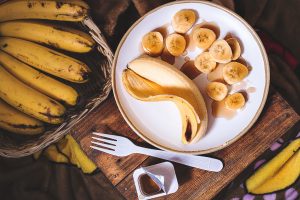
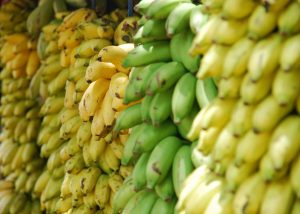
Bananas can be eaten raw or cooked, depending on their type. The Cavendish variety, for instance have a sweet, creamy flavour and are perfect to be consumed fresh, or can be fried or mashed and chilled in pies, puddings and other desserts. They are also used to flavour milkshakes, muffins, cakes and breads.
2. Plantain
Cooking banana varieties, namely plantains are an important part of Indian, Central American, Filipino and African cuisines. They are starchy with thick green or yellow skins, and are cooked into savoury dishes while unripe or immature. Plantains are a food staple in tropical regions.
3. Red Banana
As their name suggests, red bananas have a dark reddish-purple hue, and are shorter and plumper than the Cavendish variety. Ripe red bananas have a sweeter and creamier flavour profile when compared to Cavendish bananas.
4. Lady Finger
Lady finger bananas are a dessert bananas which are thinner, shorter and sweeter than most other varieties.
Nutritional Value and Health Benefits of Banana
Banans are a great addition to your daily diet as they are packed with various vitamins and minerals. Here is the nutritional content present in one medium banana:
- Calories: 112
- Fat: 0 grams (g)
- Protein: 1 g
- Carbs: 29 g
- Fiber: 3 g
- Vitamin C: 12% of the Daily Value (DV)
- Riboflavin: 7% of the DV
- Folate: 6% of the DV
- Niacin: 5% of the DV
- Copper: 11% of the DV
- Potassium: 10% of the DV
- Magnesium: 8% of the DV
Bananas are rich in resistant starch, a type of fibre which is a prebiotic. Prebiotics do wonders for your gut health and digestion as they end up as food for the beneficial bacteria (probiotics) present in your gut. Bananas are also a great addition to your diet if you want to lose weight as they are rich in resistant starch and dietary fibre which keep you feeling full for longer.
Bananas are also an excellent source of potassium. Potassium is an important mineral which improves heart health and blood pressure management. Bananas are a great way to get your daily dose of potassium as they provide 10% of the DV.
Additionally, bananas are rich in antioxidants like flavonoids and amines, which are linked to many health benefits such as boosting heart health and reducing the rish of muscular degeneration.
Final Thoughts
To wrap things up, banana is a wonderfully delicious and nutritious fruit which is the product of selective breeding using two wild species: Musa acuminata, and Musa balbisiana. The next time you have a bite of banana, think about the science behind its long developmental process which was made successful by generations of farmers.