If you have ever wondered “How often should I train abs?”, you are absolutely not alone. The core is one of those muscle groups that can be either neglected, or overstrained, based on your workout routines, goals, and your lifestyle. In the following article, we will clarify the issue, review what current science and professionals say, and help you to develop a plan to train your abs without fatigue or impeding your results.
1. Why Your Abs Deserve More Than Just Daily Crunches
Your midsection, or “core,” consists of much more than the visible six-pack muscles. It includes the rectus abdominis, external obliques, internal obliques and transverse abdomens, along with a variety of other stabilizing muscles.
Working on the core is barely about aesthetics, but here are some benefits:
- Support for spine, improved posture.
- Increased overall stability and strength (and specifically with squats, deadlifts, overhead presses)
- Less back pain and back injury.
Importantly, you need to remember that “abs” are not simply built, but visible “abs” are a function of building muscle and being at a low enough of a body-fat to see them. Not all strong cores have visible six-packs.
2. The Short Answer: How Often Should You Train Abs?
Here’s a summary guideline based on current expert opinion:
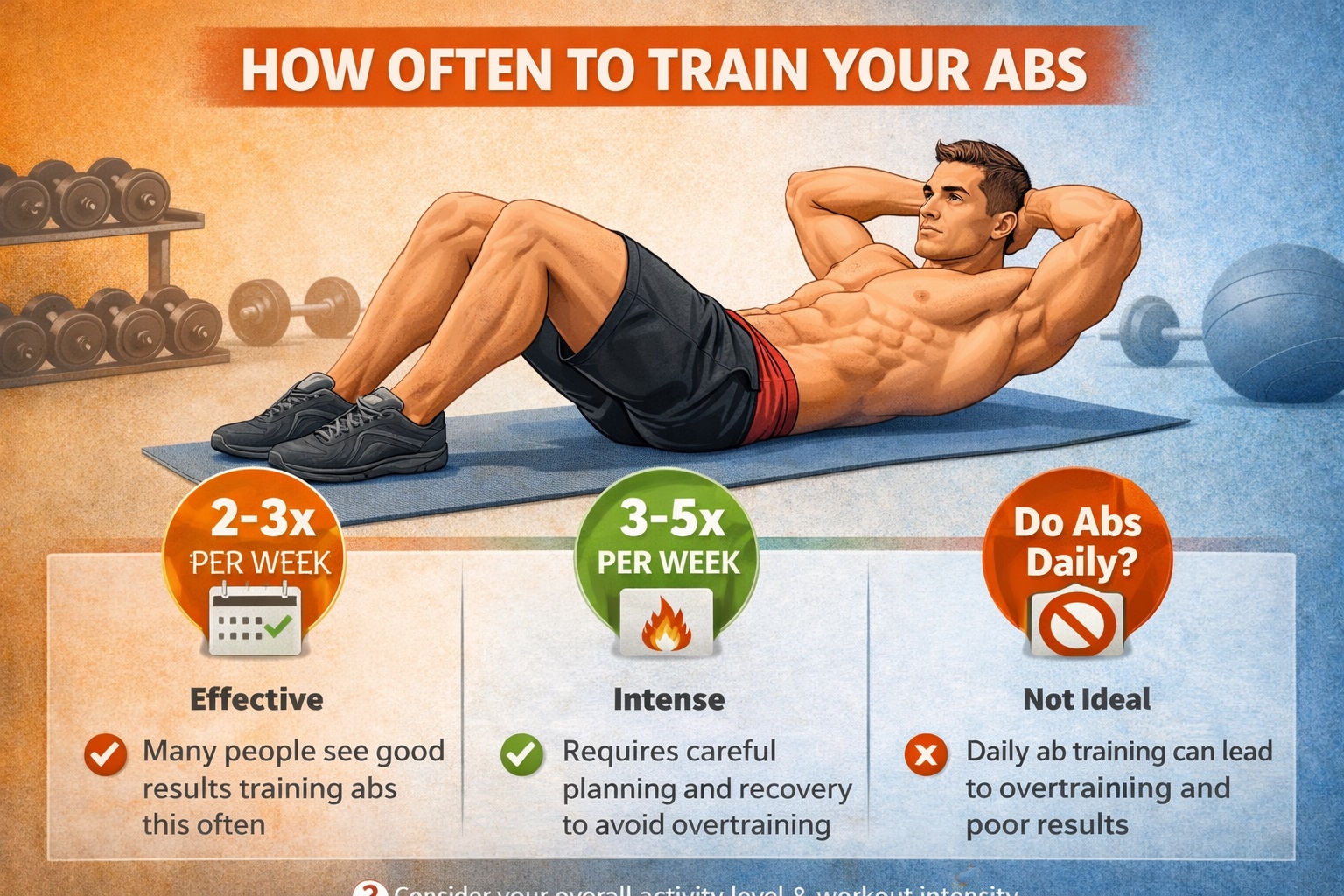
- For most people: 2 to 3 dedicated abs sessions per week is usually sufficient.
- If your routine already heavily engages the core via compound lifts, functional training, or sports, you might get away with only 1–2 abs-specific sessions weekly.
- If you're a beginner, or your main training doesn’t hit the core much: you might do 3–4 sessions per week, but still allow recovery.
Bottom line: There’s no magic in training abs every day. In fact, more frequent doesn’t always mean better. Proper stimulus plus recovery is what matters.
Michael B Jordan Men’s Health Workout Routine
3. Why Abs Can Be Trained Like Other Muscle Groups
Research shows that when volume (sets × reps × load) is kept constant, training frequency has little difference in muscle hypertrophy between doing, say, once per week versus multiple times per week.
What this means for abs is: if you’re doing enough quality work for your abs, you don’t necessarily need to attack them every day—especially because your core is being used in most workouts anyway (stabilizing, bracing, transferring force).
Also: just because abs recover slightly quicker in some people doesn’t mean they’re exempt from rest. The same principles apply: progressive overload (gradually increasing stimulus) and rest for growth.
4. How to Decide Your Ideal Frequency
Your ideal abs-training frequency depends on several factors. Here’s how to tailor it:
Fitness Level
Beginner: You might start with 1–2 ab-sessions per week, 8-12 sets per session.
Intermediate/Advanced: If you’ve been training for a while, 2–3 sessions with 10–20 sets per week is reasonable.
Recovery Capacity
- Get enough sleep, manage stress, eat well, hydrate, and you’ll recover faster.
- If you’re very sore, fatigued, or your performance is dropping, drop the frequency.
Overall Training Program
- If you’re doing heavy compound lifts (squats, deadlifts, overhead press) or high-core-involvement sports (martial arts, gymnastics, row-machine), your abs are already getting hit. You may only need 1–2 direct sessions.
- If your training is light on core or you’re mostly doing cardio/HIIT, you may want 2–3 direct abs sessions.
Your Goal
- Core strength or stability → moderate frequency, focus on variety (planks, anti-rotation, stabs).
- Visible abs / aesthetics → still 2–3 sessions, but you also need low body-fat and full-body strength. Training abs every day won’t compensate for a high body-fat %.
5. Sample Weekly Plan: How Often to Train Abs
Here are sample plans you can adopt based on your scenario:
Plan A – Beginner / General Fitness
- Monday: Full-body strength
- Tuesday: Abs session (e.g., 3 exercises × 3 sets)
- Wednesday: Rest or cardio
- Thursday: Strength
- Friday: Abs session
- Saturday: Active rest or light sport
- Sunday: Rest
→ 2 abs-sessions per week.
Plan B – Intermediate / Aiming for Visible Abs
- Monday: Upper body
- Tuesday: Lower body
- Wednesday: Abs session (core focus)
- Thursday: Full-body strength + light ab finisher
- Friday: Rest or low intensity
- Saturday: Abs session
- Sunday: Rest
→ 3 dedicated abs-sessions, plus indirect core work from strength training.
Plan C – Core Stability Focus for Sports / Functional
- Monday: Sport / functional training
- Tuesday: Abs session (focus on anti-rotation and control)
- Wednesday: Strength
- Thursday: Abs session + mobility
- Friday: Rest / light cardio
- Saturday: Sport / functional training (core is engaged)
- Sunday: Rest
→ Since core is engaged in sport days, you may only do 2 direct sessions.
Ryan Reynolds Workout & Diet Routine
6. What A Good Abs Session Looks Like
Quality over quantity. A session with good form, full activation, and progressive overload will outperform a high-frequency but sloppy routine.
Example session (for mid-level):
- Plank variation (front or side) – 3×40–60 sec
- Hanging knee raise or reverse crunch – 3×10–15 reps
- Cable/machine crunch or weighted crunch – 3×8–12 reps
- Pallof press or anti-rotation hold – 2×30–40 sec
Start with 8–12 sets per session for beginners; intermediate may go up to 12–16 sets per session.
Progression tips:
- Add more reps, time under tension, or load (for weighted exercises)
- Change the angles and muscle groups (upper, lower, obliques, stabilizers)
- Pay attention to how your body responds—if you are really sore for a few days, reduce the volume or frequency.
7. Common Mistakes & What to Avoid
- Training abs every single day thinking faster results → Overtraining risk. Muscles need rest.
- Thinking crunches alone will burn belly fat → Fat loss isn’t local. You need overall fat reduction via diet + cardio + strength.
- Ignoring form → Improper technique can lead to lower-back/neck strain.
- Neglecting the rest of the core (obliques, transverse abdominis, anti-rotation) → Balanced core = better function + aesthetics.
- Not syncing with other training → If you just add abs on top of heavy leg/hip/back days without adjusting load, you may hinder recovery.
8. Bringing It Back to You
Here’s how you can answer the core question for yourself:
- What’s your current training routine ? (How much core-engagement already exists?)
- What’s your goal ? (Stability, performance, visible abs?)
- How’s your recovery ? (Sleep, nutrition, soreness, energy levels?)
- Start modest: e.g., 2 sessions/week of dedicated ab work for 4–6 weeks.
- Monitor progress: How do your abs feel? Are you recovering well? Any back/neck discomfort?
- Adjust: If you’re recovering fine and want more definition, increase to 3 sessions/week or increase sets. If you’re tired/sore, scale back.
9. Final Word
Now, the question is: “How often should you train abs?” The short answer, for most people, is that 2-3 times per week of direct training of the abs is probably best. More is not necessarily better, and less is likely just fine. It really all depends on the balance of stimulus + recovery, overall program integration, using the exercise properly, and frequency balance with your goal.
Train smart, recover well, and your abs will show up—not because you hammered abs every day, but because you did a good job of incorporating abs effectively and executed that in a balanced way.